
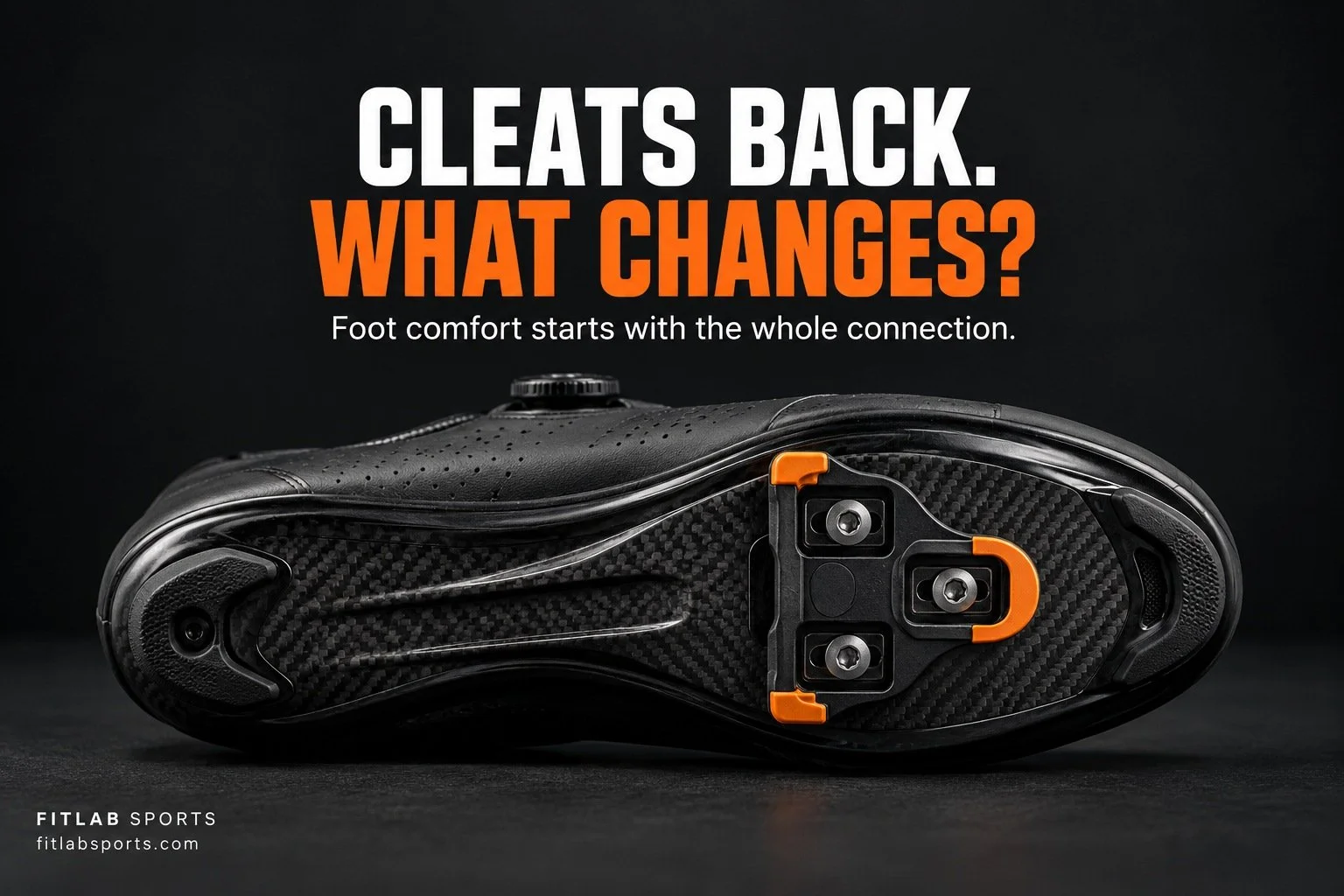
Understanding the advice starts with understanding what it is meant to change.
Jason Barcoff | Fit-Lab Sports
“Should I move my cleats back?” “Will that stop my feet going numb?” “If my shoes have stiff soles, shouldn’t they spread the pressure?”
We hear these questions in the studio and see them across social media, blogs, and Reddit. Often, they begin with reasonable advice. The difficulty is what happens between hearing a recommendation and understanding what it means for our own feet.
“Moving the cleat back reduces load,” for example, leaves an important question unanswered: load on what? A change in ankle demand, pressure beneath the forefoot, and the sensation of comfort are related, but they are not interchangeable. Research supporting one outcome does not automatically establish the others. 1,2,3,4
What moving the cleat actually changes
Moving the cleat toward the heel places the pedal spindle farther back relative to the foot. This can shorten the pedal force’s lever arm around the ankle and reduce demand on the calf–Achilles system. A stiff outsole still transmits that force; it does not eliminate the leverage. 1,5
A 2026 study of ten novice cyclists found lower modeled Achilles tendon strain with a 20-millimeter rearward position. That is useful evidence about a particular loading effect. It does not establish that the same adjustment reduces forefoot pressure, prevents injury, or makes every rider more comfortable. 1
Nor does farther back automatically mean more power. A study of twelve competitive cyclists found changes in joint movement with smaller cleat adjustments, without significant differences in sprint performance or measured physiological variables. 6
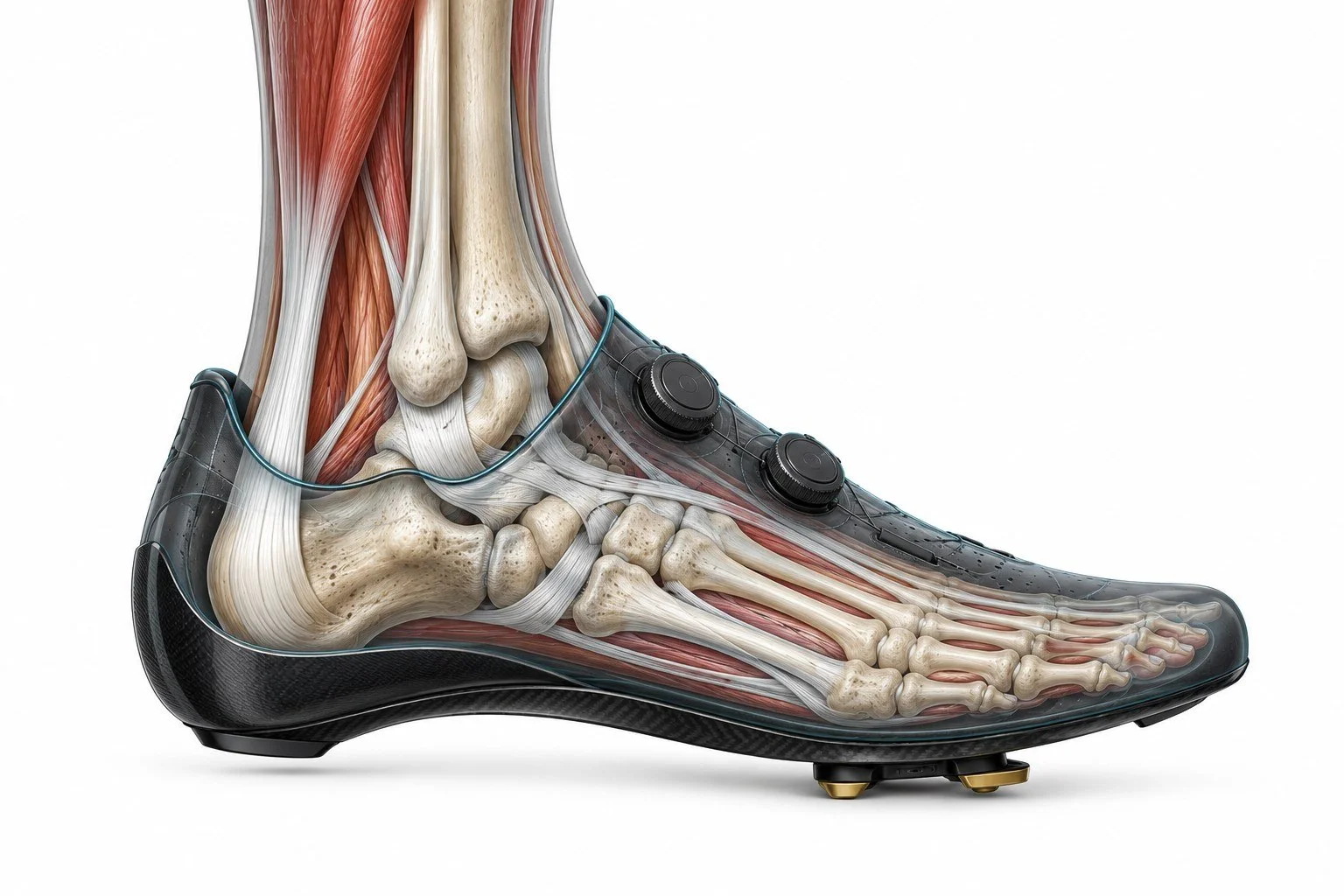
A stiff sole is only part of the connection
The foot inside the shoe is not a rigid block. Its joints, arch, and soft tissues influence how it accepts support and manages load. Our fitting approach considers how the foot functions, how its tissues respond to contact, and how much movement is available—not simply whether the arch looks high or low. A
The outsole resists bending, but that alone does not ensure even pressure beneath the foot. In one study, the carbon-composite shoe tested produced higher peak forefoot pressure than the plastic-soled comparison. That finding concerns those shoes under the test conditions, rather than all carbon soles. 3
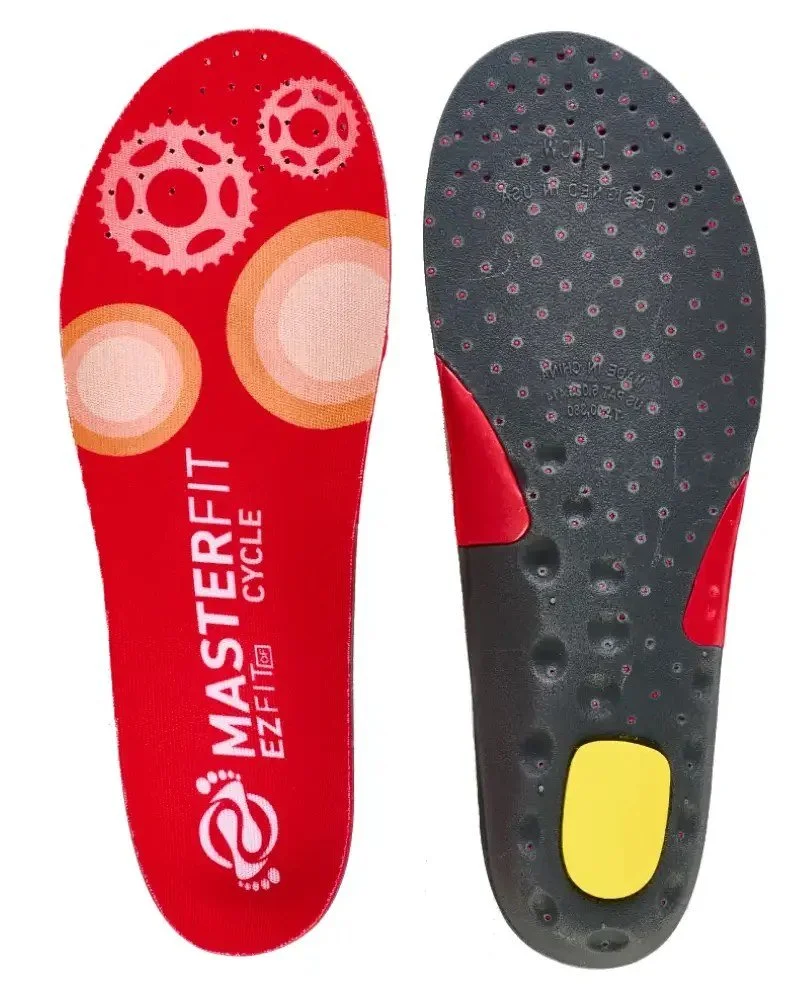
Footbed research also shows that pressure can decrease in one region while increasing elsewhere. Spreading or redistributing load is different from removing it. This is why “more support” needs context too: where is the support, how does it contact the foot, and how does it feel during pedaling? 4,A
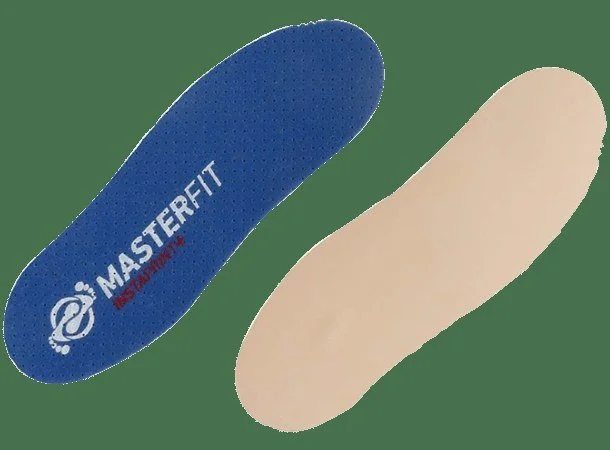
Both drop-in and custom footbeds can provide support inside the shoe. Selection should reflect the foot’s contour and function, the space available, and the rider’s response. The goal is appropriate contact and comfort, with the footbed evaluated as part of the complete fit. A
Start with where the foot sits
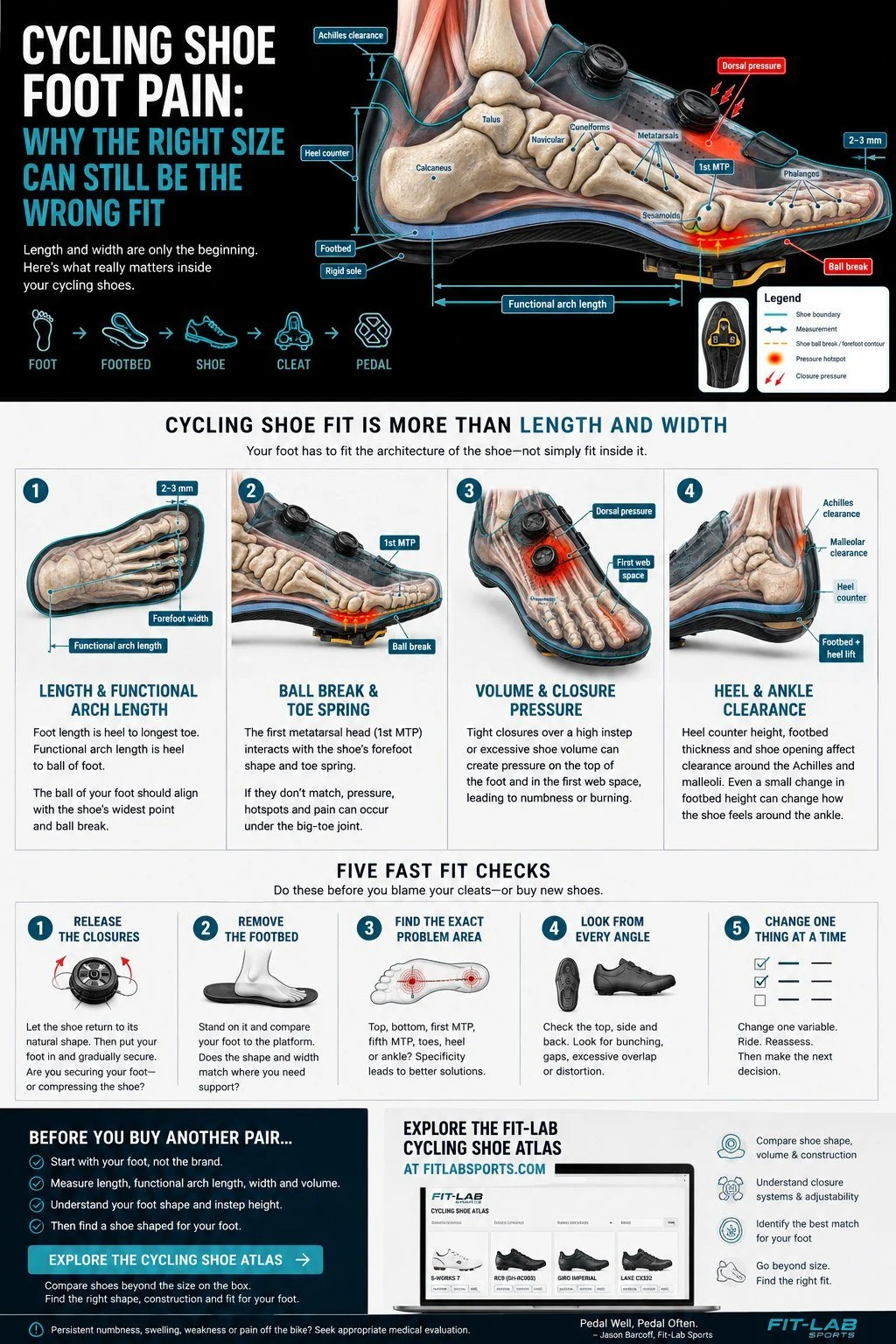
Before asking a cleat adjustment to solve discomfort, look inside the shoe. Overall length, heel-to-ball length, forefoot width, instep volume, tissue compliance, and heel retention all help explain the fit. The intended socks and footbeds belong in that assessment. A,B
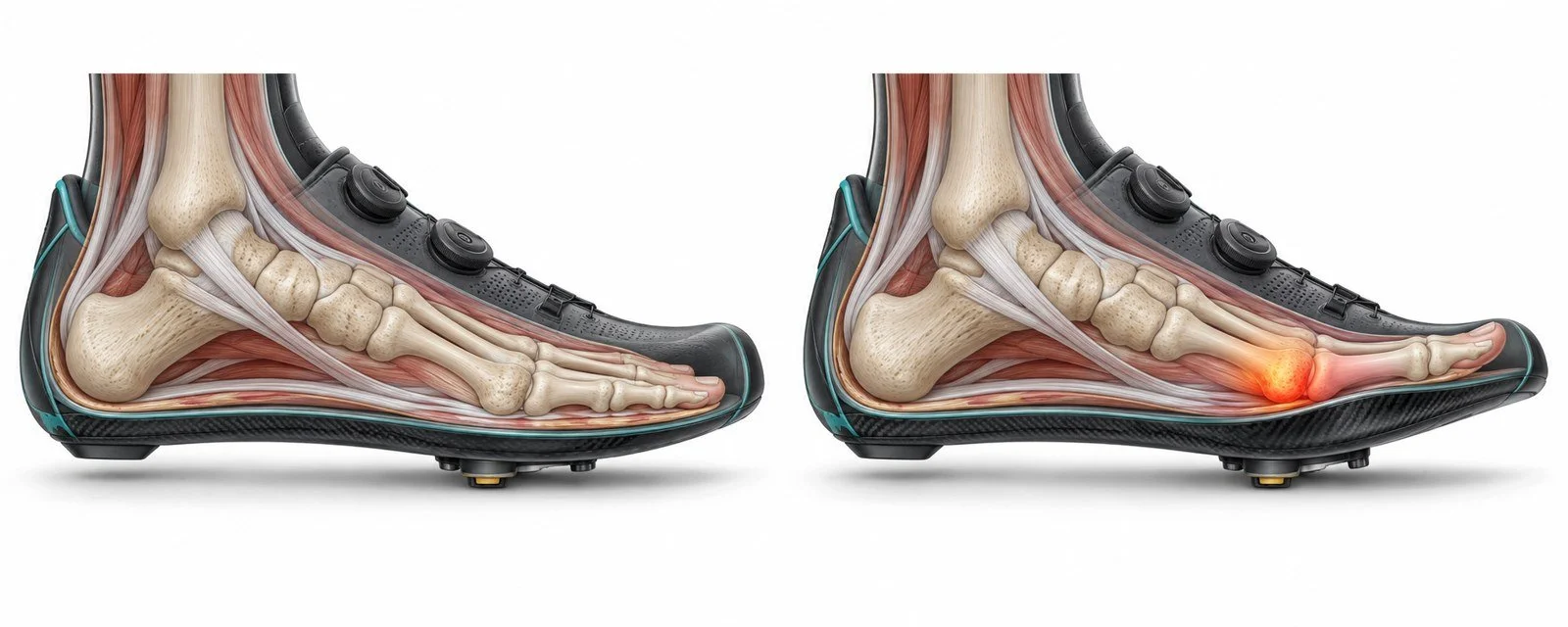
Check where the metatarsal heads—the joints at the ball of the foot—rest on the usable forefoot platform. Consider how the upward curve toward the toes, or toe spring, matches the foot, and whether the upper holds securely without excessive compression. Moving the cleat beneath the outsole cannot widen that platform or create more instep space. A,B
This does not mean cleat changes cannot help. In a small clinical series, correcting markedly forward cleats was followed by reduced foot pain. However, the study had no control group and did not establish why symptoms improved. It supports considering cleat position, without making it the explanation for every painful foot. 2
Turn advice into a useful fitting decision
“Under the big-toe joint after an hour” tells us more than “my shoes hurt.” Describe the location, sensation, and timing, then connect any proposed adjustment to a clear purpose. Are we assessing shoe contact, ankle demand, or a change in symptoms?
In practice, make a defined adjustment and reassess at comparable power, cadence, and posture. Cleat changes can affect effective reach to the pedal, so check ankle behavior, pelvic movement, and saddle contact too. Record accompanying saddle adjustments rather than attributing every result to the cleat alone. These are practical fitting checks, not guaranteed benefits. 5,A
That brings us back to the opening questions. Advice from an expert, a friend, or an online discussion becomes more useful when we understand its purpose and limits. “Less demand at the ankle” may be exactly what someone meant—even if we heard “less pressure everywhere in the foot.”
These articles aim to close that gap. A qualified bike fitter or shop experienced in cycling shoe fit should help connect the explanation to your feet, footwear, and riding, then check whether the change achieved its purpose. Ask what is being changed, why it may help, and how you will evaluate it together.
The goal is a comfortable, repeatable connection built around you—and a clearer understanding of the choices that get you there.
Measure. Match. Position. Observe. Reassess.
Continue with Cycling Shoe Fit Is More Than a Size.
Pedal well, pedal often.
Explore the Cycling Shoe Atlas fit overview
Sources and further reading
Numbered links identify research. A–B identify our teaching framework and artwork. Practical fitting interpretations are distinguished from study findings.
1. Firminger & Asmussen (2026). Cycling Cleat Positioning Influences Achilles Tendon Strains, but at What Energetic Cost? Ten novice cyclists; tendon strain was modeled, not an injury outcome.
2. Bonfatti et al. (2024). The effect of cleat position on foot pain in cyclists. Uncontrolled clinical series correcting markedly forward cleats.
3. Jarboe & Quesada (2003). The effects of cycling shoe stiffness on forefoot pressure. Specific shoe comparison at 400 W; not a cleat-position trial.
4. Influence of carbon fiber foot orthoses on plantar pressure distribution in cycling (2012). Eleven pain-free triathletes; regional pressure redistribution.
5. Van Sickle & Hull (2007). Is economy of competitive cyclists affected by the anterior–posterior foot position on the pedal? Eleven competitive cyclists; full text reviewed, including positional adjustments.
6. Acute effects of small changes in antero-posterior shoe-cleat position on physiological and biomechanical variables in road cycling (online 2022). Twelve competitive cyclists; acute testing does not settle long-ride comfort.
A. Masterfit Masters Plus Cycling Workbook, pp. 4–7, 10, 14, 18, 24, 28–29. Author-supplied educational framework and illustrations, not independent trial evidence.
B. Fit-Lab: Cycling Shoe Fit—Beyond Size and Width / Cycling Shoe Atlas overview. Existing Fit-Lab educational graphic; comparison and assessment guidance.